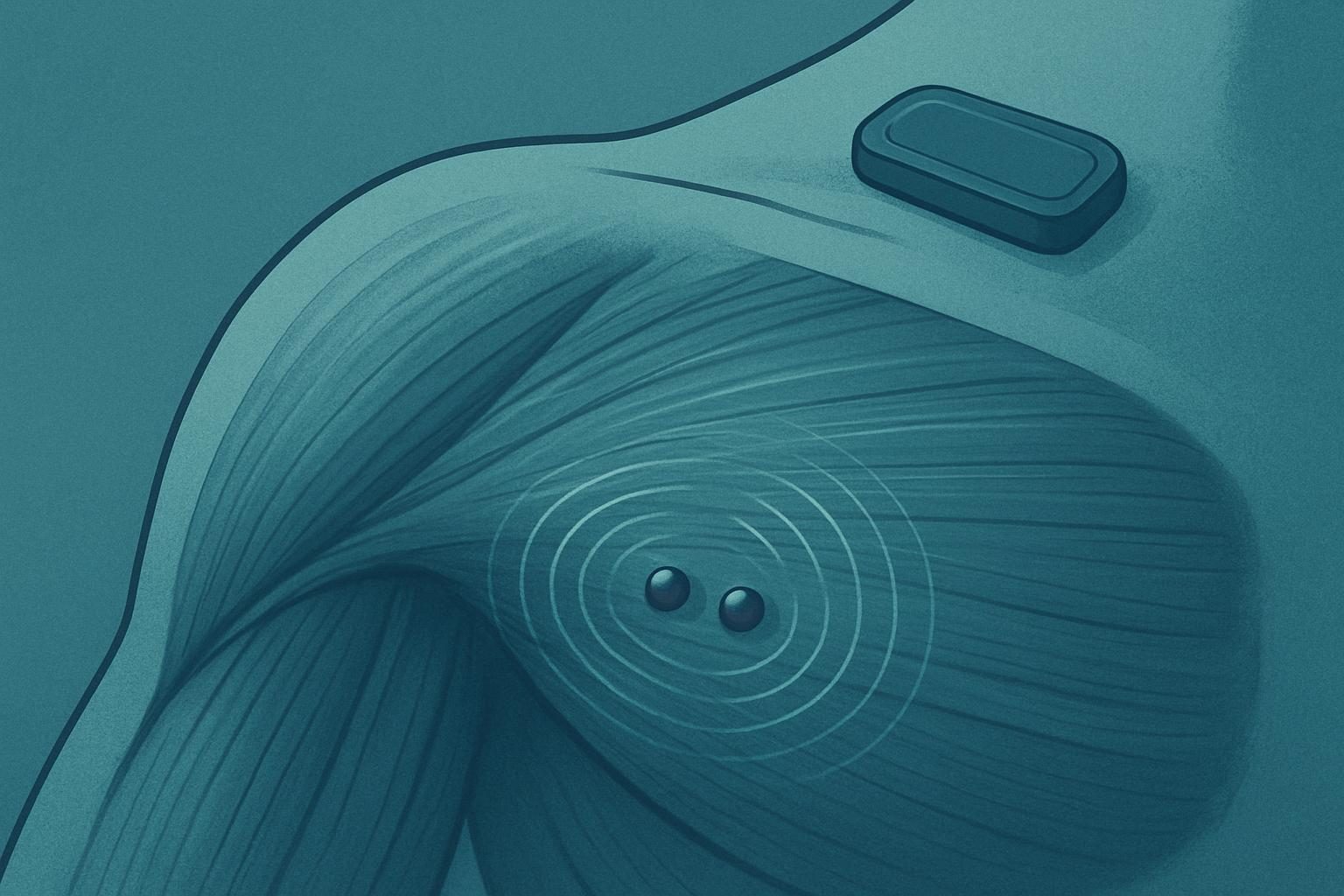
MIT engineers have introduced an innovative technique that employs tiny magnetic beads implanted within muscles to track muscle movement with high precision, aiming to enhance control of neuroprosthetic limbs for amputees. This approach offers a more direct measurement of muscle dynamics compared to traditional surface electrodes.
Neuroprosthetic limbs typically rely on electrical signals from muscles—measured via skin electrodes known as electromyography—to infer muscle activation and control prosthetic movement. However, surface electrodes can be unreliable, impacted by signal fading, cross-talk from adjacent muscles, and interference from sweat, limiting safe and natural limb control.
The new method, termed magnetomicrometry, involves implanting pairs of 3-millimeter magnetic beads into muscles. When the muscle contracts or stretches, the spatial distance between the beads changes. External sensors placed on the skin then track these changes wirelessly to calculate muscle length and contraction velocity accurately.
In a recent study published in Nature Sensors, MIT researchers tested this approach on three individuals with below-knee amputations who underwent surgical procedures to create an agonist-antagonist myoneural interface (AMI). This interface reconnects muscle pairs to preserve natural proprioceptive feedback, facilitating intuitive prosthetic control.
During experiments, participants performed controlled muscle movements to manipulate a cursor on a screen using signals derived from magnetomicrometry, implanted electrodes, and surface electrodes. Results indicated that the magnet-based system provided more accurate and stable signals than surface electrodes and was comparable to implanted electrodes but with less invasiveness.
The magnetic beads, composed of neodymium, iron, and boron coated with biocompatible layers, can transmit signals through up to 6 centimeters of tissue, making them suitable for various muscle depths. The minimally invasive nature of this technique could make advanced prosthetic control accessible to a broader population of amputees.
While promising, the technology is still under investigation, and the current studies have involved a limited number of human participants. Further clinical trials are necessary to validate long-term safety, implant durability, and functional benefits during everyday prosthetic use.
MIT scientists are now conducting larger-scale studies to evaluate the effectiveness of magnetomicrometry-controlled prostheses in real-world scenarios, potentially paving the way for commercial development of more natural and responsive neuroprosthetic limbs.
Source & further reading
Magnetic sensors track muscle movement, for better prosthetic limb control ↗Source published 2026-10-29. This report was prepared with AI assistance from the linked primary-source material. Claims and limitations should be checked against the original announcement or research.